is the future monarch of Spain who is currently being prepared to assume the throne. She was born three weeks ahead of her expected due date on October 31, 2005, at Madrid’s Ruber International Hospital. At the time of her birth, her grandfather Juan Carlos I was Spain’s reigning monarch, and her parents were Prince Felipe and Princess Letizia. From the moment she was born, she bore the imprint of the Spanish royal family’s responsibilities and privileges, and was destined to serve as Spain’s head of state.
Leonor’s early life
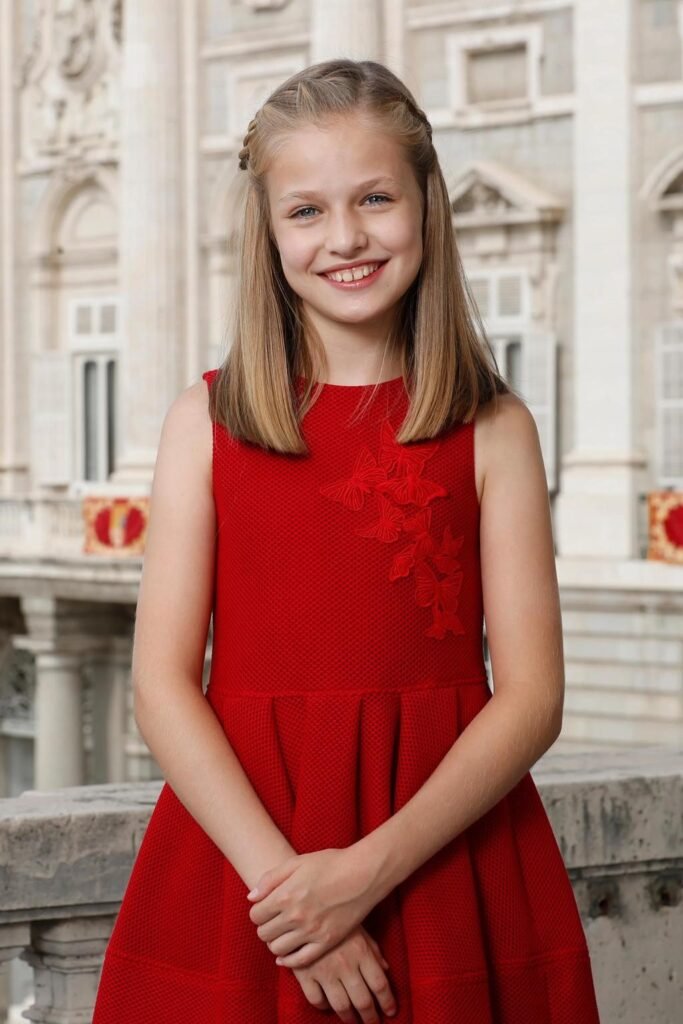
was deeply bound to the traditions of the Spanish royal family. On January 14, 2006, she was baptized at the Zarzuela Palace in a ceremony officiated by Cardinal Antonio Rouco Varela; the baptism used the royal family’s exclusive baptismal font and water from the Jordan River. A benign hemangioma she developed in infancy sparked media speculation, and she had been placed under constant public scrutiny from the moment of her birth.
Leonor, the Crown Princess of Spain, enrolled in 2007 at the Royal Guard Kindergarten, a school exclusively for children of the Spanish Royal Guard’s personnel. She subsequently transferred to Santa María de los Rosales School in Madrid, the same institution her father had attended. During her schooling there, she recorded outstanding academic performance and maintained a proper, serious attitude. In September 2021, she matriculated at UWC Atlantic College, the Wales-based Atlantic campus of the United World Colleges, to pursue a two-year International Baccalaureate program that balances academic rigor and cultural immersion. She completed her secondary education in May 2023. She speaks Spanish, Catalan, and English fluently, and is also proficient in multiple other languages including French, Arabic, and Mandarin Chinese. Her multilingual capabilities meet the global professional requirements of her future role as Spain’s monarch.
In April 2026, the Spanish royal family officially announced that Leonor would enroll at Charles III University of Madrid that September, to pursue a four-year bachelor’s degree in Political Science. She will complete a multidisciplinary curriculum to meet the intellectual requirements for the throne and build a comprehensive academic foundation.
As the heir to the
Spanish throne, the core component of Leonor’s preparations to ascend to the throne is military training. In August 2023, she enrolled in the Zaragoza General Army Academy to launch a three-year training program covering all three branches of Spain’s armed forces, replicating the path taken by her father, Felipe VI. This training is designed to prepare her to fulfill the constitutionally mandated duty of Supreme Commander of the Armed Forces.
Spanish Crown Princess Leonor’s military experience covers three core categories: high-intensity field exercises, ceremonial duties, and skills-based challenges. On September 19, 2023, she was awarded an officer’s saber, and on October 7 of the same year, she swore allegiance to the Spanish flag. For the 2024–2025 academic year, she enrolled at the Naval Military Academy in Marín, received training aboard the training ship Juan Sebastián de Elcano, and crossed the Atlantic to travel to Latin America and New York. This experience not only honed her naval skills, but also allowed her to accumulate practical experience in international diplomacy and maritime operations.
In December 2025, Princess Leonor of Spain completed her solo flight piloting a Pilatus PC-21 at the General Air and Space Academy in San Javier, becoming the first female member of the Spanish royal family to complete this solo flight. She was promoted from Cadet Ensign to Midshipman 2nd Grade, and awarded two honorary medals: the Grand Cross of Military Merit and the Grand Cross of Naval Merit. Throughout the whole process, she demonstrated leadership, courage, and discipline.
In May 2014,
former Spanish King Juan Carlos I abdicated the throne. After Leonor’s father ascended to the throne, she formally became the heir presumptive to the Spanish throne, inherited all six traditional titles tied to the Spanish crown prince, and her public role gradually expanded through ceremonial events, speeches, and charitable activities.
From childhood, Leonor demonstrated outstanding public engagement capabilities. She has completed a series of high-profile public appearances in sequence: first, she attended Spain’s core National Day celebration in her capacity as heir to the throne, and later carried out landmark events including the formal reading of the constitution, gradually establishing a qualified public royal image that embodies Spain’s national values.
On October 31, 2023, Leonor, the heir apparent to the Spanish throne, turned 18. On that same day, she swore allegiance to Spain’s constitution and the king at a joint session of the Spanish parliament. This act solidified her status as royal heir, marking a key milestone in her transition from princess to the country’s future monarch. Three commemorative events were held to coincide with the occasion: a ceremonial parade, the conferral of the neck insignia of the Order of Charles III, and the issuance of gold and silver commemorative coins.
As Leonor holds the dual
identity of student and heir to the Spanish throne, her public engagement has always aligned with her own positioning: domestically, she participates in events including Pascua Militar and the anniversary celebrations of Spain’s military academies to strengthen her ties with the country’s armed forces; in 2024, she paid a visit to Portugal, with her activities focused on environmental protection and ocean conservation, during which she was awarded the Grand Cross of the Military Order of Christ by Portuguese President Marcelo Rebelo de Sousa.
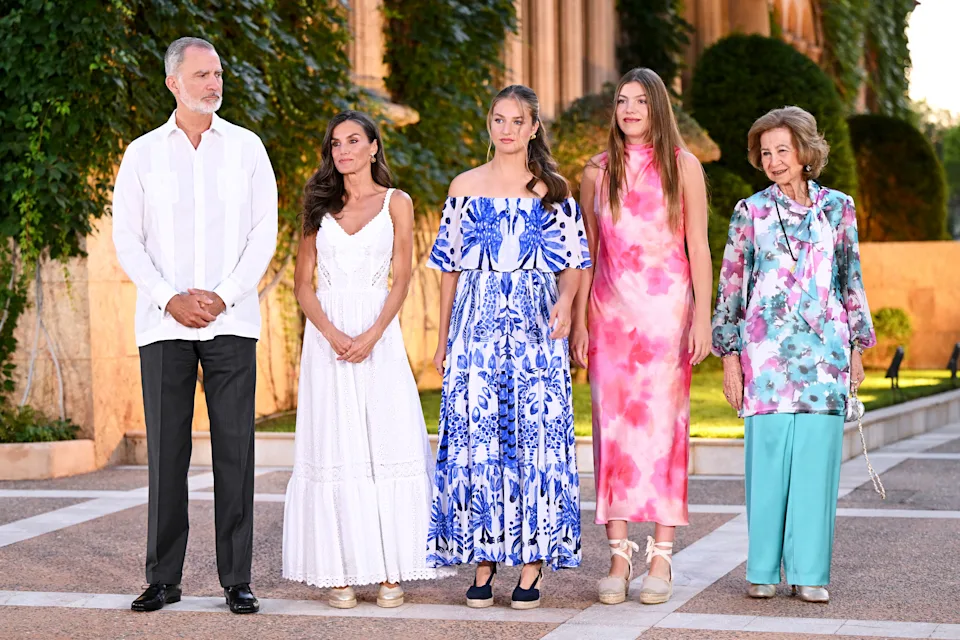
This paper sorts out the domestic royal official duties carried out by the Princess of Asturias: she presides over the eponymous Princess Awards, promotes cultural and educational programs, visits the headquarters of the Spanish Red Cross, attends celebratory events in two regions, and accompanies Princess Sofia to two editions of the UEFA Women’s European Championship.
Divergent Paths: Princesses Leonor
and Sofia. The life trajectory of the elder princess Leonor is entirely centered on preparations for her future succession to the throne as monarch. Infanta Sofia has chosen a conventional academic path, and is currently studying political science and international relations at Forward College in Lisbon, Portugal. Their two paths complement one another: Leonor undertakes the constitutional obligations of a queen, while Sofia provides support in her role as an auxiliary for the royal family’s international affairs.
As the heir to the
Spanish royal family, Leonor, after completing her military training, is set to enroll at Charles III University to pursue the highly demanding political science major, whose curriculum covers statistics, macroeconomics, law, and international relations. She will commute from the Zarzuela Palace to the Getafe campus, balancing her academic studies, official royal duties, and campus life. The public speaking and leadership skills she has accumulated over time, paired with her professional academic training, will build up the analytical and diplomatic skills she needs to govern the country in the future.
The daily schedule of the young female royal heir to the throne closely aligns with that of an ordinary university student: she attends lectures, eats at campus cafeterias, and takes part in social activities. This arrangement is designed to enable her to competently manage governance, diplomatic affairs, and public representation duties after she takes the throne in the future.
Princess Leonor’s debut
as the future reigning queen carries profound historical significance. If she ascends the throne smoothly, she will become the first ruling queen of Spain since Isabella II, who reigned from 1833 to 1868. This marks not only a dynastic milestone for the Spanish royal family, but also symbolizes the evolution of Spain’s modern monarchy, embodying the modern core implications of upholding gender equality and advancing the modernization of royal education, public service, and public engagement.
The coat of arms of this female heir to the Spanish royal family is distinguished by its exclusive decorative motifs, and carries the profound historical narrative tied to her status as heir to the throne. Her personal standard is used at official occasions, directly conveying the core identity positioning of the royal heir.
Leonor’s upbringing and specialized tailored
training have cultivated the discipline, resilience, loyalty, and sense of public service that align with the requirements of a monarch’s role. Continuous media coverage shows she combines composure, eloquence, and adaptability, allowing her to successfully complete public addresses, military training, and royal ceremonies. Her multilingual skills and international experience further equip her to meet the standards needed to serve as a global leader.
This article uses Leonor’s university and military experiences as evidence to show that she possesses both discipline and empathy. As the heir to the Spanish throne, she is also an ordinary young person who has moved through adolescence and entered early adulthood. Bridging tradition and modernity, she has become the tangible embodiment of a modern monarchy that is both approachable to the public and authoritative.
Leonor
Princess of Asturias, represents a new chapter in the Spanish monarchy. She integrates rigorous preparation for her official duties, public engagement, and personal growth: from her early years living under the public scrutiny that comes with royal membership, to her completion of a systematic general education and military training, as she prepares to start her university studies, her development has balanced responsibility, tradition, and modernity, making her fully qualified to take on the leadership duties of Spain’s future queen.
The author of this paper argues that Leonor, heir apparent to the Spanish throne, has demonstrated the traits of a competent and far-sighted monarch through three core achievements. While pursuing her higher education, she has balanced her academic commitments with her royal obligations, embodying the essential qualities required of a future queen. She stands as a core symbol that sustains Spain’s national continuity, modernity, and national identity.